When Ransomware Hits a Title File: Zero Trust Lessons for Real Estate Agencies
On August 26, 2025, the ransomware tracking site ransomware.live added a new name to its list of Play ransomware group victims: Premier Realty Group, a U.S. real estate brokerage. Security research firm DeXpose published a breach report the following day confirming the Play group had compromised the brokerage’s systems, and the incident later showed up on classactionu.org’s running list of real estate and property management data breaches. None of these sources detail how many client records were touched, but the shape of the attack matches a pattern researchers have tracked across multiple industries for years.
For a brokerage, an incident like this isn’t just a technical headache. Client financial details, signed contracts, and transaction records tied to some of the largest purchases people make in their lives sit on the same systems attackers are after.
Real estate agencies don’t always think of themselves as cybersecurity targets. They think of themselves as people who show houses and close deals. But the Premier Realty Group breach is a reminder that any business handling money transfers, personal financial records, and legal documents looks attractive to ransomware groups, whether or not it has an IT department to match.
Why Real Estate Agencies Look Like Easy Targets
A single home purchase pulls together a long list of participants: the buyer, the seller, two agents, a lender, a title company, an escrow officer, sometimes an attorney, and an inspector. Each of them exchanges sensitive information by email, shared drive, or portal, often under time pressure to meet a closing date.
That mix creates a lot of entry points. Agents work from laptops at open houses, phones in their cars, and home networks that nobody is monitoring. Brokerages often rely on a patchwork of MLS logins, CRM tools, and e-signature platforms, each with its own password, and not always its own strong authentication.
Wire transfer fraud is a particular risk in this industry because closings involve large sums of money moving on a deadline. The National Association of Realtors’ own wire fraud data has identified it as a recurring threat in residential transactions. Title and settlement firms see the same pattern from the other side of the deal: Lilly Title & Settlement’s Q1 2025 wire fraud report and FundingShield’s Q1 2025 transaction risk analysis both flagged wire fraud attempts as a persistent part of the closing process, with scammers timing their move to the exact moment funds are set to transfer. If an attacker compromises a single email account in that chain, whether an agent’s, a title company’s, or an escrow officer’s, they can insert fraudulent wiring instructions at exactly the moment a buyer is least likely to question them.
The Trust Problem With Old-School Security
Traditional network security was built around the idea of a secure office with a firewall at the edge. Everyone inside the network was assumed safe; everyone outside had to ask permission to get in. That model doesn’t map well onto how a brokerage actually works.
Agents are rarely sitting inside a protected office network. They’re logging into the MLS from a coffee shop, pulling up contract templates from a tablet at a showing, or checking transaction status from a personal phone. Once a brokerage’s data lives in cloud tools and gets accessed from dozens of locations and devices, the “safe inside, dangerous outside” idea stops being useful.
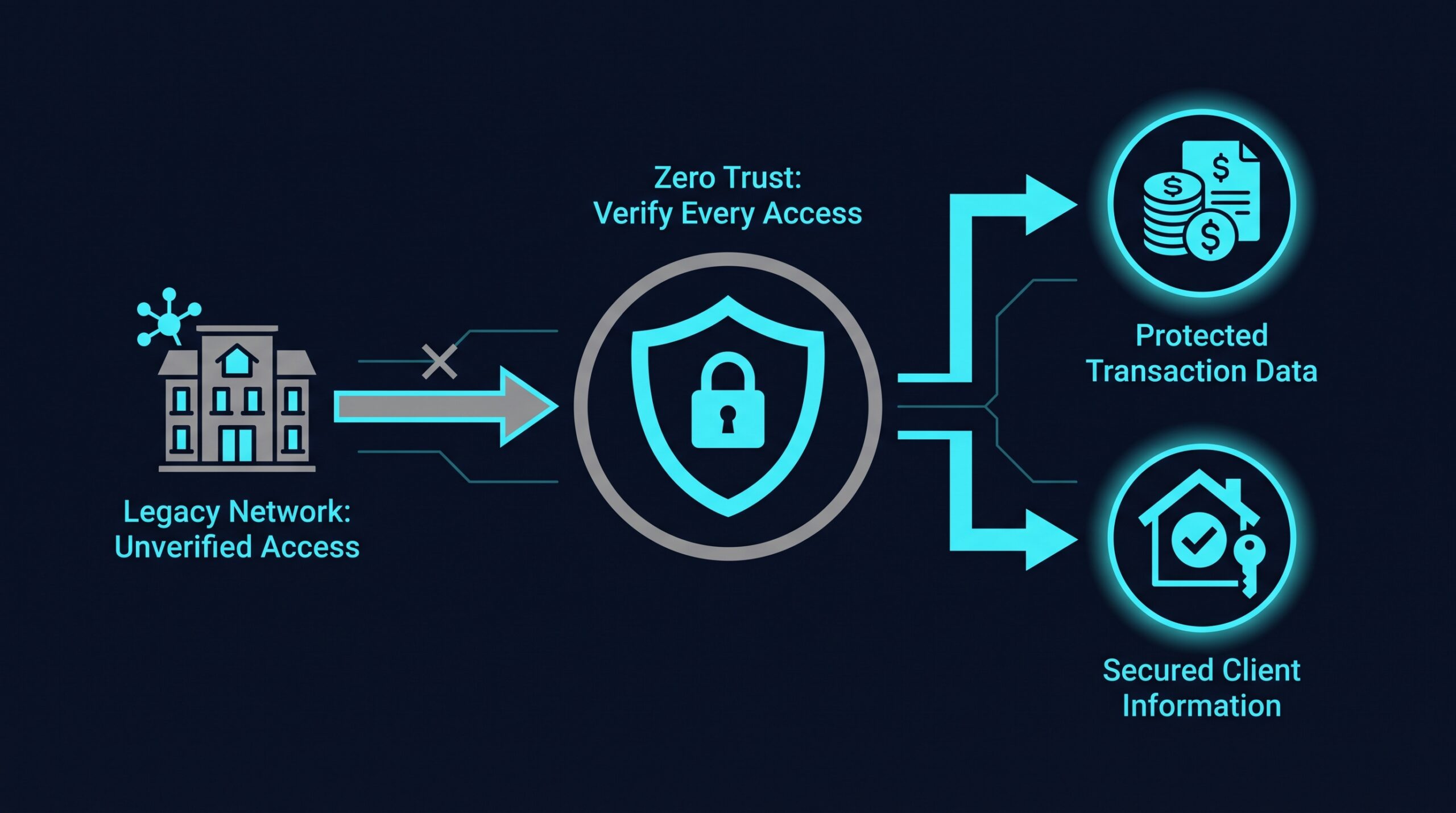
This is the gap that Zero Trust Network Access is built to close. Instead of trusting a device or user because they’re on the right network, it checks who someone is, what device they’re using, and what they’re trying to reach, every time, regardless of location. NIST laid out this approach formally in Special Publication 800-207, which treats every connection as unverified until proven otherwise.
What Zero Trust Actually Means for a Brokerage
Zero Trust isn’t a single product you install. It’s a set of principles applied across how people and devices connect to your systems: verify identity continuously, grant the minimum access needed, and assume that any connection could be compromised until proven otherwise.
Verifying Identity Before Every Connection
A password alone is not strong proof of who someone is, since credentials get phished, reused, or leaked in breaches unrelated to real estate at all. Multi-factor authentication, paired with single sign-on across the tools agents use daily, makes it harder for a stolen password to turn into full account access.
Limiting Access to What Each Role Needs
Not every person at a brokerage needs access to every file. A transaction coordinator working one closing doesn’t need visibility into every other agent’s deals, and a part-time showing assistant doesn’t need access to brokerage financial records. Applying least-privilege access means that if one account is compromised, the damage stays contained to what that account could actually see.
Checking Device Health, Not Just Credentials
An agent’s personal laptop might be running outdated software or missing basic security settings, and a username and password won’t catch that. Zero Trust systems can check a device’s security posture before letting it connect, which matters in an industry where agents frequently use their own devices rather than brokerage-issued equipment.
Segmenting Access by Transaction
Instead of one broad network where everything is reachable once you’re in, access can be broken into smaller segments tied to specific deals, file folders, or client records. A compromised account tied to one transaction doesn’t open the door to every other client’s file sitting on the same server.
Watching for Unusual Behavior Continuously
Verification shouldn’t stop at login. Continuous monitoring can flag things like a login from an unfamiliar location, unusual download activity, or access attempts outside normal working hours, giving a brokerage a chance to respond before a small compromise turns into a full breach.
Where Wire Fraud Fits In
Business email compromise, where an attacker gains access to a legitimate email account and uses it to redirect a wire transfer, is one of the more damaging risks tied to weak access controls in real estate transactions. It doesn’t always require ransomware or anything especially sophisticated. Often it just requires one reused password and no multi-factor authentication standing in the way.
Zero Trust principles cut down on the number of ways that single point of failure can occur. By requiring strong identity verification for anyone accessing email or transaction systems, and by limiting what a compromised account can reach, brokerages shrink the window an attacker has to interfere in a closing before someone notices something is off.
Building a Practical Rollout
Most brokerages don’t need to overhaul everything at once. A reasonable starting point looks like this:
- Map who accesses what. List every system agents, staff, and outside partners touch, from the MLS to the document management platform to shared drives.
- Start with identity. Turn on multi-factor authentication for email and core business tools first, since this closes one of the most common entry points attackers use.
- Move to Zero Trust Network Access for remote connections. Rather than a traditional VPN that grants broad network access once connected, a Zero Trust Network Access platform like NordLayer lets a brokerage set access rules by user, role, and device, which fits a workforce that’s rarely in one office. If you sign up through some of the links in this article, EdgeTrustNetwork may earn a commission at no extra cost to you.
- Extend access controls to outside partners carefully. Title companies, lenders, and attorneys often need temporary access to specific files, and that access should expire when the transaction closes, not linger indefinitely.
- Train agents on recognizing manipulation attempts, particularly around wire instructions, since technology controls work best paired with people who know what a suspicious request looks like.
Choosing Tools Without Overcomplicating Agent Workflows
A brokerage’s biggest implementation risk isn’t choosing the wrong vendor. It’s choosing something so cumbersome that agents work around it. Most real estate professionals are not technical by trade, and a security tool that adds friction to showing a house or sending a contract will get quietly ignored.
Cloud-based Zero Trust platforms tend to fit this industry better than older site-to-site VPN setups, since agents rarely need to connect to a single fixed office network. Look for solutions with straightforward mobile apps, single sign-on integration with tools agents already use, and administrative dashboards that a smaller office can manage without a dedicated IT team. Comparing a few platforms against your actual team’s daily workflow, rather than against a feature list alone, tends to produce better adoption.
This matters more than it might seem. RSM US’s Middle Market Business Index, in its 2025 cybersecurity snapshot, pointed to cybersecurity spending and readiness as a growing concern among middle-market businesses generally. Real estate firms without dedicated security staff fall squarely into the category that research describes.
The Cost of Waiting
The Premier Realty Group breach isn’t an isolated curiosity. It’s a preview of what any brokerage handling sensitive financial and legal documents is exposed to without stronger access controls. Other incidents point to the same pattern: breach notices tied to the August 2023 Rapattoni MLS attack, the July 2025 FlexMLS and Matrix platform compromises, and the April 2025 CRM Residential (Community Realty) breach have been documented through ClaimDepot’s data breach notices and Strauss Borrelli PLLC’s breach investigation filings, with details cross-checked against classactionu.org’s broader breach database. Different platforms, different years, same target profile: firms sitting in the middle of large, time-sensitive transactions.
Closings run on trust, between buyer and seller, agent and client, title company and lender. Zero Trust access controls exist to make sure that trust is backed by verification at every step, so the next ransomware group that goes looking for an easy target finds a brokerage that checked its locks before the deal closed, not after.