ZTNA vs VPN: Why the Login Screen Isn’t Where the Real Difference Lives
A remote employee logs into the company VPN from a coffee shop. Their credentials were phished three weeks earlier and sold on a forum nobody at the company reads. The login succeeds because the password is correct. What happens next is where the VPN and its replacement, ZTNA, stop looking anything alike.
With a traditional VPN, that stolen credential now sits inside the company network, the same network the file server, the accounting software, and the internal admin tools all live on. With Zero Trust Network Access, that same credential gets checked again, and again, against a much narrower set of permissions before it touches anything. That difference, not the login screen, is the real comparison small business owners need to understand.
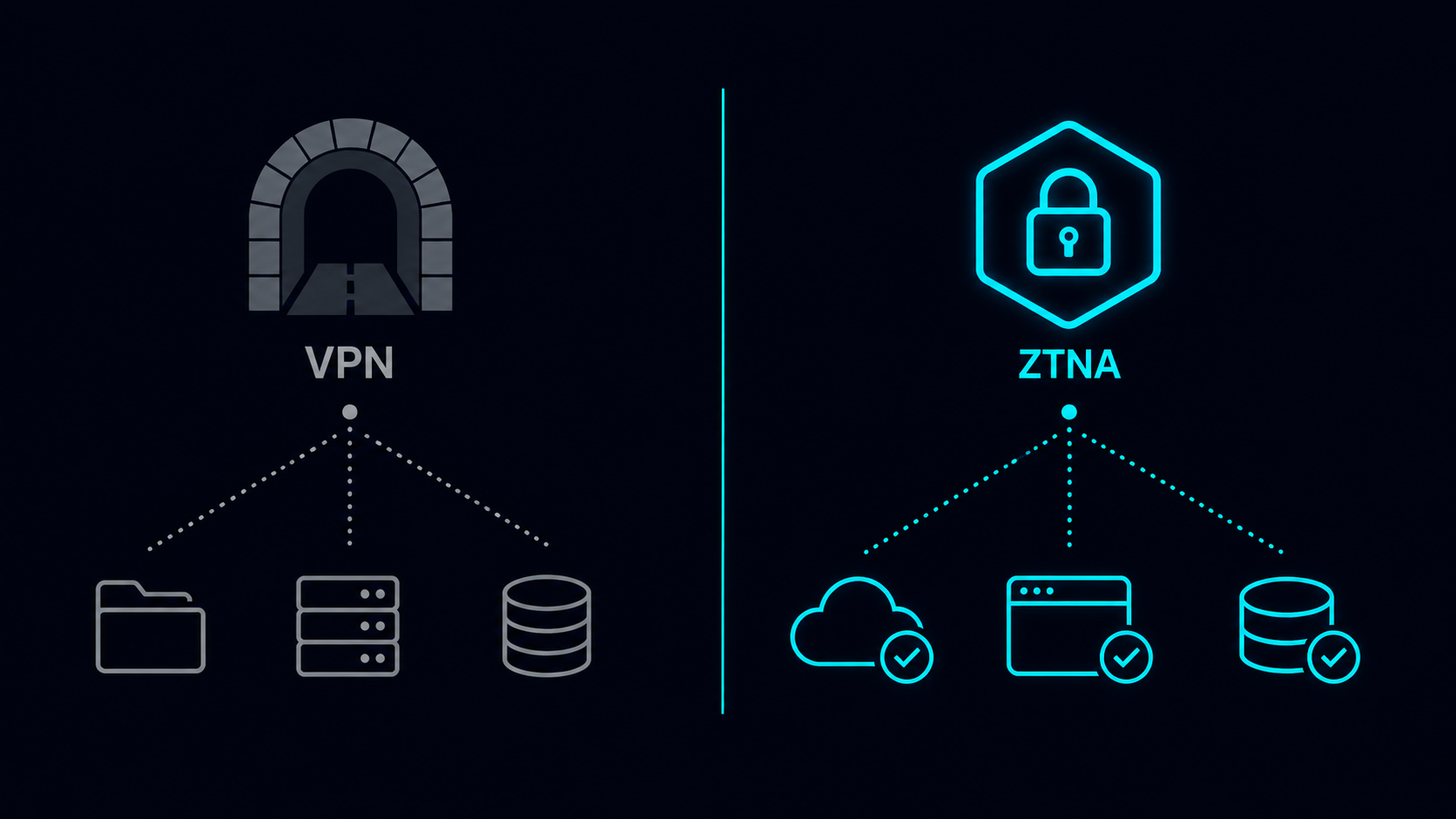
What a VPN Actually Does
A VPN creates an encrypted tunnel between a device and the company network. Once that tunnel is up, the device is treated as if it were plugged into an office router. It can usually see and reach far more than the person using it actually needs for their job.
This was a reasonable design in the 1990s and 2000s, when most work happened inside a building and remote access was the exception. The VPN’s job was to extend the office network outward, not to question what happened once someone was let in. Trust was granted at the perimeter and rarely checked again after that.
The problem is that this model treats “authenticated” and “trustworthy” as the same thing. They aren’t. A device can present valid credentials and still be compromised, unpatched, or operated by someone who bought access on a criminal marketplace rather than earned it.
How ZTNA Changes the Access Model
Zero Trust Network Access starts from the opposite assumption: no user or device is trusted by default, even after login. Instead of connecting to the network, a person connects to a specific application, one at a time, and only after their identity, device posture, and context are verified for that request.
An employee who needs the CRM gets a path to the CRM. They don’t get a path to the file server, the internal wiki, or the finance system just because they’re connected. If they later need the file server, that’s a separate request, evaluated on its own terms.
The “Never Trust, Always Verify” Mechanism
This is often summarized as “never trust, always verify,” a phrase that sounds like a slogan but describes an actual mechanism. Access decisions get made continuously, using signals like device health, location, time of access, and behavior patterns, rather than once at login and never again.
The federal government formalized a version of this approach in OMB memo M-22-09, which pushed U.S. agencies toward Zero Trust architectures built around per-application access decisions rather than network-wide trust. The logic behind that mandate, that broad network trust is an unnecessary risk, applies just as directly to a 30-person business as it does to a federal agency.
The Attack Surface Difference, In Practice
This is where the comparison stops being theoretical. If a VPN credential is compromised, the attacker’s blast radius is the network itself, everything reachable from wherever that tunnel lands. If a ZTNA credential is compromised, the blast radius is limited to whatever single application that access grant covers.
That distinction matters more than it might sound like on paper, because breaches rarely stay contained to where they start. An attacker who lands inside a flat network can move sideways, looking for the one unpatched server or forgotten admin account that turns a single stolen password into a company-wide incident. ZTNA is built specifically to make that lateral movement harder, since there’s no open network to move laterally across in the first place.
What the Data Says About VPN Risk
The theory holds up against the numbers reasonably well, though the numbers deserve some precision. Zscaler’s ThreatLabz 2025 VPN Risk Report, based on a survey of security professionals, found that 56% of organizations say their VPN creates ongoing security or compliance challenges for their teams, not that 56% suffered a confirmed breach through it. The same report, drawing on MITRE CVE data, found that publicly disclosed VPN-related vulnerabilities grew 82.5% between 2020 and 2025.
Ransomware groups in particular seem to have noticed how much a single foothold at the network edge can be worth. Coalition’s Cyber Threat Index 2025 found that 58% of ransomware incidents in its claims dataset originated through perimeter appliances, a category that includes VPNs and similar edge devices. Zscaler’s same 2025 report found 92% of surveyed organizations expressed concern about VPNs specifically as a ransomware entry point.
Verizon’s 2026 Data Breach Investigations Report, published in May 2026, found that 22% of breaches involving exploited vulnerabilities traced back to VPN or edge-device weaknesses. That’s a narrower slice than “most frequently exploited” territory, but it’s still a large enough share that it shows up consistently across separate datasets from separate companies rather than in just one report.
None of this means VPNs are uniquely broken software. It means a VPN’s design, granting broad access once a credential clears the door, makes a single successful compromise disproportionately valuable to an attacker.
Why So Many Organizations Are Making the Switch
The market has responded accordingly. Gartner’s Market Guide for ZTNA projected that by 2025, ZTNA would account for roughly 70% of new remote access deployments, a target year that has now effectively arrived. Zscaler’s 2025 report found 65% of enterprises plan to replace their VPN infrastructure within a year.
This isn’t purely defensive posturing either. IBM’s 2025 Cost of a Data Breach Report identified Zero Trust maturity, meaning identity verification, segmentation, and continuous access checks working together rather than ZTNA alone, as one of several factors associated with lower breach costs, with organizations at higher Zero Trust maturity saving an average of $1.76 million per breach compared to those with little or none. Contained incidents simply cost less to investigate, remediate, and disclose than ones that spread across an entire network.
Okta’s State of Zero Trust Security Report found that 61% of organizations had already launched some form of Zero Trust initiative as of its 2023 edition, suggesting this moved past early-adopter territory some time ago rather than being a brand-new trend. Mordor Intelligence projects the ZTNA market growing from $39.58 billion in 2025 to $96.75 billion by 2030. Worth flagging: other market research firms define the ZTNA category differently and arrive at figures an order of magnitude apart, so treat the dollar totals as directional evidence of growth rather than a precise industry-wide number.
The Cost Question: What ZTNA Actually Takes to Deploy
None of this is free, and a small business owner weighing the switch deserves a straight answer on cost rather than a vague promise of savings. Meriplex, a managed security service provider that sells ZTNA implementations, published an ROI analysis putting mid-market ZTNA setup at roughly $75,000 to $150,000, plus $30,000 to $60,000 annually in ongoing costs. Because Meriplex sells these deployments, its figures reflect one vendor’s implementation territory rather than independent market research, and no comparable independent pricing study turned up in researching this piece. Treat the range as a rough planning benchmark, not a quote.
That same analysis found that cyber insurance premium reductions tend to become visible within 12 to 18 months, separate from whatever a business saves by avoiding a breach altogether. A five-person consultancy with no sensitive customer data faces a different calculation than a healthcare billing company handling protected records. The right move is to size the investment against what’s actually being protected, not against a single vendor’s average.
Do You Need to Rip Out Your VPN?
Not necessarily, and most organizations don’t do it all at once. A common and reasonably practical path is a hybrid approach: keep the VPN running for legacy systems that weren’t built to support application-level access controls, while routing newer, cloud-based tools through ZTNA.
This lets a business shrink its exposure gradually, application by application, rather than treating the switch as an all-or-nothing infrastructure project. Over time, as legacy systems get replaced or retired anyway, the VPN’s footprint shrinks on its own.
Several ZTNA vendors build products specifically for this transition period. NordLayer, for example, is a ZTNA vendor product from Nord Security that markets application access alongside more traditional VPN functionality, letting a business run both models at once rather than switching in a single cutover. That description comes from the vendor’s own positioning, not from an independent comparison of NordLayer against competing products, and it hasn’t shown up as a named entry in major independent analyst reports. The underlying idea, that a business can support both architectures during a transition instead of picking one on day one, is a real and useful option regardless of which vendor a business eventually chooses.
The Real Difference, Restated
Go back to that stolen credential in the coffee shop. Under a VPN, the question the network asks is simply “is this login valid?” Under ZTNA, the question becomes “is this login valid, for this specific application, right now, from this device, in this context?”
That second question is harder to answer, which is exactly why it’s harder for an attacker to slip past.