NordLayer vs Cisco Duo: Do You Need Network Access Control or Identity Verification First?
A contractor on your team logs into your project management tool from a coffee shop laptop. A vendor needs temporary access to one shared folder on your server. Your office manager wants to stop worrying about someone guessing an employee’s password and getting into your payroll system. Somewhere in researching how to fix all three problems, you run into two names that keep showing up together: NordLayer and Cisco Duo.
Here’s the thing that trips people up: these two tools solve different problems, even though they both get filed under “zero trust security” in marketing copy. One controls who can prove they are who they say they are. The other controls what a verified person or device is allowed to reach once they’re in. Confusing the two, or assuming you only need one, is where a lot of small business security plans go sideways.
The Confusion Comes From Overlapping Marketing, Not Overlapping Function
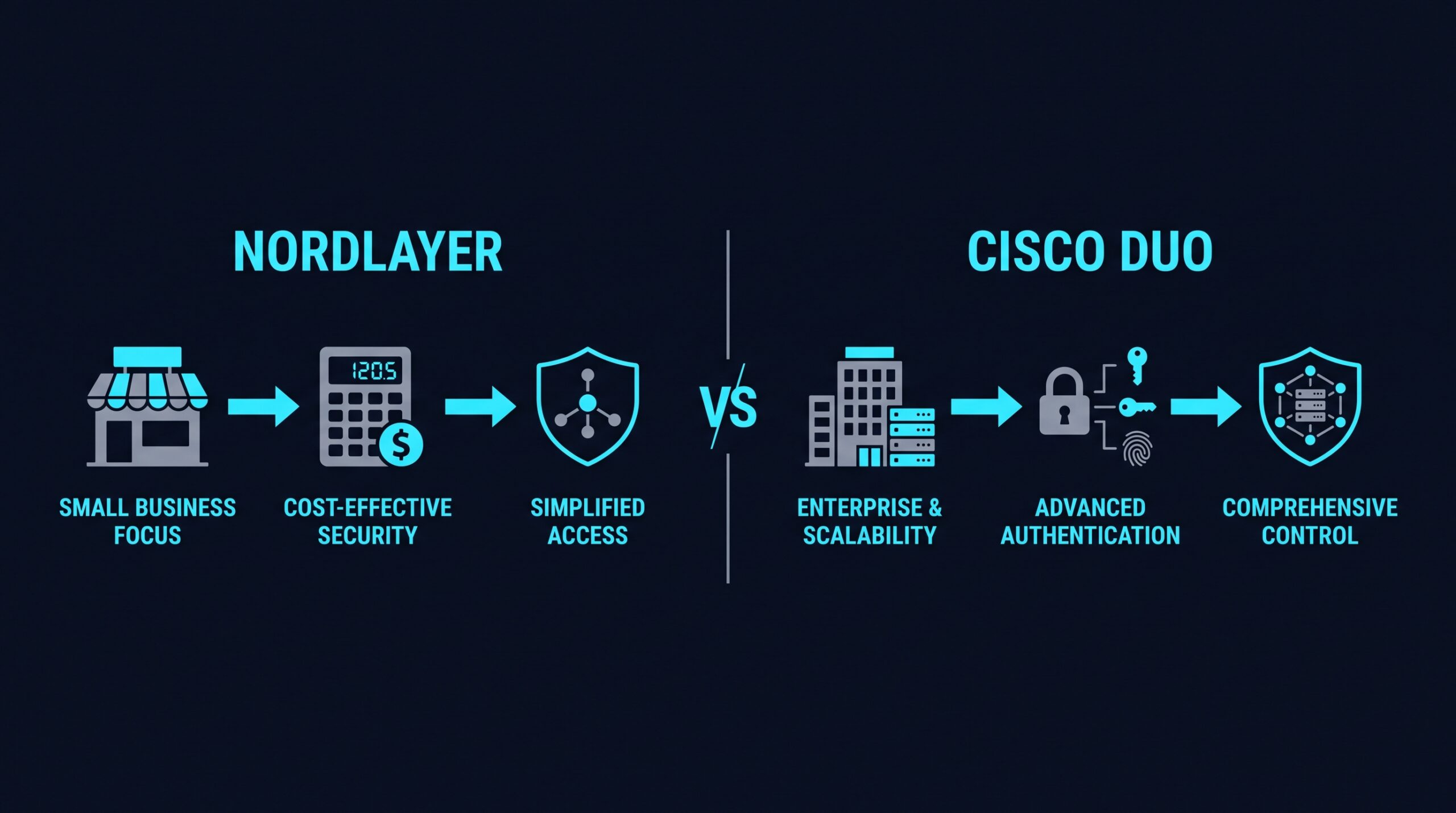
Both companies talk about zero trust. Both mention least-privilege access. Both show up in searches for “secure remote access for small business.” That’s because zero trust isn’t a single product, it’s a set of principles: verify identity, check the device, limit access to only what’s needed, and don’t assume anything inside your network is automatically safe.
The trouble is that no single tool does all of that alone. Identity verification and network access control are separate layers of the same strategy, built by companies that approach the problem from different starting points.
What Cisco Duo Actually Does
Cisco Duo started as a multi-factor authentication (MFA) company and Cisco brought it into its security portfolio to strengthen identity verification across its broader product line. Its core job is answering one question: is this login attempt actually from the person it claims to be from?
Disclosure: if you sign up through some of the links in this article, EdgeTrustNetwork may earn a commission at no extra cost to you.
Push-Based Authentication and Device Checks
Duo’s most recognizable feature is the push notification: someone tries to log in, and a prompt goes to their phone asking them to approve or deny it. That single step closes off a huge category of attacks that rely purely on stolen or guessed passwords, since a compromised password alone isn’t enough to get in.
Duo also checks device health before granting access, things like whether an operating system is up to date, whether disk encryption is turned on, or whether the device is jailbroken. This means an employee’s phone or laptop can be evaluated for risk before it’s ever allowed near a login screen, not just after.
Where Duo Sits in Your Stack
Duo typically plugs into your identity provider or directly into applications through protocols like SAML, OIDC, or RADIUS. It doesn’t build a private network for your team to travel through. It sits at the login gate for the applications and systems you already have, deciding whether to let a specific authentication attempt through.
What NordLayer Actually Does
NordLayer operates at a different layer entirely. Rather than deciding whether a login attempt is legitimate, it controls what a device can reach on your network once it has already been authenticated somewhere else.
ZTNA and Network Segmentation
NordLayer is built around Zero Trust Network Access (ZTNA) principles: instead of putting a remote worker on a flat network where they can see everything, it creates specific, limited pathways to specific resources. A contractor who needs one shared folder gets a route to that folder, not a general-purpose tunnel into your whole office network.
This is done through segmentation, private gateways, and access rules tied to user groups or device posture. It’s the practical answer to “how do I stop one compromised laptop from becoming a doorway into everything.”
Remote Access and Site Connectivity
NordLayer also covers more traditional needs like secure remote access for distributed teams and site-to-site connections between offices. For a small business with a handful of remote employees and maybe one or two physical locations, this replaces what used to require a dedicated IT person managing a traditional VPN appliance.
So Which One Do You Actually Need?
If your biggest worry is stolen or weak passwords letting someone into your email, banking portal, or cloud accounting software, that’s an identity problem, and Cisco Duo is built to answer it directly. If your worry is that anyone who gets past the login screen, whether a legitimate employee or an attacker with stolen credentials, can then wander freely across your internal systems, that’s a network access problem, which is closer to what NordLayer is designed for.
Most small businesses eventually need both, just not always at the same time or budget stage.
A Practical Way to Decide Priority
Start by asking where your actual exposure is highest right now:
- If you have no MFA at all on core business accounts, that’s the more urgent gap to close first, since credential theft remains one of the most common ways attackers get initial access, according to Verizon’s annual Data Breach Investigations Report series.
- If MFA is already in place but every employee still has broad access to shared drives, admin panels, or servers regardless of their role, that’s a network segmentation problem worth addressing next.
Can They Work Together?
Yes, and in many setups they’re meant to complement each other rather than compete. A common pattern looks like this: Duo verifies the person and checks the device at login, then NordLayer’s access controls determine what that now-verified session is actually allowed to touch on the network. One answers “who are you,” the other answers “what can you do now that we know.”
This layered approach matches how larger enterprise security teams already think about zero trust, they rarely rely on one vendor for the whole architecture. Small businesses can apply the same logic at a smaller scale, without needing a dedicated security team to manage it.
Cost and Setup Complexity
Cisco Duo tends to be quicker to roll out for identity-only use cases, since it’s mainly wrapping MFA around logins you already have. NordLayer’s setup involves a bit more network planning upfront, deciding gateways, user groups, and access policies, but that planning is what delivers the segmentation benefit in the first place.
Neither is inherently more expensive across the board; pricing depends on user count, feature tier, and whether you’re buying through a broader Cisco security bundle or a standalone NordLayer plan. It’s worth requesting current quotes directly rather than assuming one is the budget option, since packaging changes over time.
The Real Takeaway
Neither tool is a replacement for the other, and treating this as a head-to-head contest misses the point. Duo closes the door on stolen passwords. NordLayer decides what happens once someone is already standing in the hallway. A small business that only installs one is leaving the other half of the house unlocked.
Back to that contractor in the coffee shop: with Duo, you know it’s actually them logging in. With NordLayer, you make sure they only ever reach the one folder they were supposed to see in the first place. Neither tool alone answers both questions, which is exactly why the smartest small business security plans usually end up asking each of them to do the job they’re actually built for.